
Kitchens That Come Together: What We Learned Through an Exchange in Marseille at the Kouss Kouss Festival
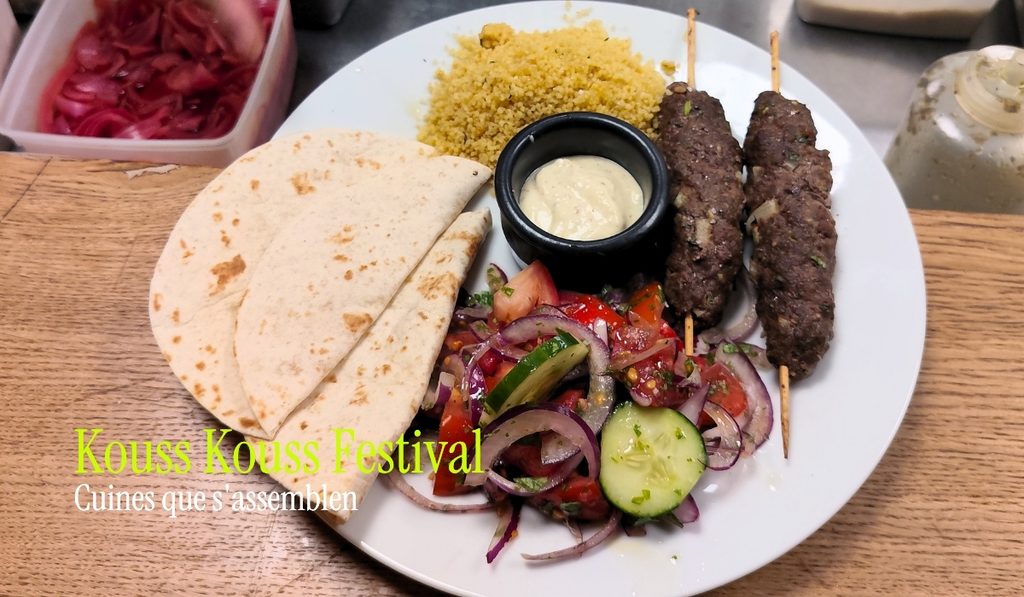
From September 2 to 6, Mescladís participated in the Kouss Kouss Festival in Marseille and exchanged ideas with organizations that, in another city, are asking themselves the same questions we are: how to turn cooking into dignified work, a welcoming environment, and rights.
The Kouss·Kouss Festival is a culinary and cultural event that fills Marseille with magic and couscous every year: Now in its 9th year, the festival features more than 200 partners—restaurants, markets, public spaces, and charity cafeterias, as well as hospitals and schools—with whom it explores the richness of Mediterranean cuisine, this year through aromatic and wild herbs, the central theme of this edition.
The Festival is organized by Les Grandes Tables, a cultural and gastronomic production company founded in 2006 in Marseille with the aim of being more than just a restaurant: “a place for gatherings, for culinary and cultural sharing, and for reflection on cuisine and food.” Its underlying philosophy is that gastronomy can be culture and common ground, bringing together professionals and enthusiasts, local and international practices, to open up what they call “new culinary territories.” Twenty years later, that same spirit shapes the festival: to preserve and pass on the Mediterranean culinary heritage, to foster a genuine dialogue between the two shores of the Mediterranean—each edition invites chefs, producers, artists, and scholars from Algeria, Lebanon, Morocco, Tunisia, and Turkey—and to bring this cuisine out of elite circles and into the neighborhoods.
And why a couscous festival?
Because few ingredients hold so much history and so clearly illustrate what it means to share a meal. In December 2020, UNESCO inscribed it on its Intangible Cultural Heritage list thanks to a joint nomination submitted by Algeria, Morocco, Mauritania, and Tunisia. It was described as a dish that accompanies “the life of communities”—births, weddings, funerals—that is passed down orally from generation to generation, and that transcends social boundaries: women and men, young and old, sedentary and nomadic. There are as many couscous recipes as there are families. In Europe, and especially in France, couscous was brought by migrants and is now the third favorite dish of the French: a very concrete example of how cuisine not only integrates but also enriches the gastronomic heritage of the country that welcomes it. A dish without a single recipe is, perhaps, the best possible metaphor for a festival that does not seek uniformity, but rather shared diversity at the same table.
We went there to share, cook, eat, and get to know a whole network of people who make the kitchen a space for inclusion. Social cooking isn’t an isolated project: it’s a network of cities that, each in its own way, are tackling the same challenges. This post highlights what the organizations we shared with are doing, and why getting to know them seems just as important to us as cooking with them.
In "Chantier i Festin": Two Ways of Understanding Cuisine as a Tool for Social Integration
The tour will begin with visits to two organizations that are part of Marseille's social fabric.
Chantier is a solidarity-based, participatory association founded in 2008 with the goal of promoting an alternative economy, sustainable consumption, and social cohesion through shared culinary and cultural projects. Its main projects are:
- La Cantine du Midi: a participatory and socially conscious restaurant offering home-style, healthy, and affordable cuisine for neighborhood residents and workers.
- La Drogheria: a grocery store promoting health and social inclusion, which prioritizes locally sourced products and fair trade.
- Criscito / Boulangerie: artisanal baking and pastry workshops open to the community.
- Lokal 36: the shared space at 36 Rue Bernard, the association's operational headquarters and a cultural gathering place.
- Community Garden: a space for collective gardening at the Le Couvent (IG) facilities.
Festin —the joy of moving forward together—is an association in the Noailles neighborhood founded on June 15, 1987, that harnesses the culinary arts and the restaurant industry as a vehicle for social transformation and integration: to convey values of sharing and social interaction, create opportunities for togetherness, and highlight transferable and universal skills. Each year, it helps approximately 400 people find employment through projects such as:
- La Table de Cana Marseille: a social enterprise in the restaurant industry, founded in 1992.
- Des Étoiles et des Femmes: a program that enables women from disadvantaged neighborhoods to earn a CAP certificate in culinary arts through training with gourmet chefs.
- Les Beaux Mets: the first bistronomic restaurant for vocational rehabilitation in a correctional facility in France.
- Tournesol: A free six-month culinary training program for refugees, in collaboration with Refugee Food.
We’ll wrap up with dinner at NBTA House, a restaurant and guesthouse in the medina of Tangier, which is also participating in the festival: the Mediterranean itself, a country just across the way.
La Cuisine de l'Arc and Le Bouillon de Noailles: A Cooperative Restaurant as a Safe Haven
Le Bouillon de Noailles is an association that promotes initiatives aimed at professional integration, providing information, combating precariousness, experimentation, and cultural projects centered on food and cooking. The projects are designed and carried out in collaboration with residents and members of the city center, bringing together neighbors, students, and professionals. It operates four community kitchens:
To the Noailles neighborhood:
- La Cuisine de l'Arc: a cooperative and socially conscious restaurant—where the Mescladís kitchen team set up shop on Thursday the 3rd and Friday the 4th.
- Le Petit Bouillon: cooking workshops, raising awareness about balanced and sustainable eating, and shared meals.
- L'Espace des enfants autonomes: a set of teaching tools and resources designed to support the learning of children ages 6 to 11.
In the Saint-Mauront neighborhood:
- La Cuisine du 101: with SoliHa Provence, a community kitchen for those who don't have one, and a third sociocultural space for the neighborhood.
In addition, Le Bouillon de Noailles is also supporting four other projects:
- Le Bon Bouillon: an awareness program promoting healthy and balanced eating.
- Le Bon Repas: a charitable program that helps people in precarious situations access meals.
- Ingredient: a participatory magazine featuring recipes and stories collected in Marseille. Each issue revolves around a specific theme: a place, a dish, or a particular moment in the life of the neighborhood.
- Tambouille: a publication featuring writings and drawings created during cooking workshops.
AUP: support for asylum seekers, providing shelter and food
We were fortunate enough to meet the AUP—Association des Usagers de la PADA, the Reception Platform for Asylum Seekers—which defends the rights of asylum seekers in Marseille and manages a self-managed Reception Center for Asylum Seekers (CADA), where about forty residents—including families—have been living since 2020, with weekly distribution of food packages.
Ràdio Grenouille and La Friche: Speaking Out Loud
That same Friday, we shared our story and experience live on Radio Grenouille (88.8 FM), a community radio station in Marseille that has been operating since 1981 and serves as the cultural hub of the Friche Belle de Mai, a meeting place for the community network that includes more than 30 participating organizations.
The residency at La Cuisine de l'Arc
For two days, the Mescladís team shared kitchen duties and service with the local team from La Cuisine de l'Arc, preparing two couscous recipes: the first, as a tribute to the mother of one of the chefs, using her recipe; the second, serving the couscous with homemade kefta.
Marseille is, perhaps, the city that best illustrates why this work is worthwhile. A historic gateway to the Maghreb, West Africa, Armenia, Italy, and so many other places, its identity has been shaped by successive waves of people who are still learning to live together. Each of the organizations we’ve met—from their neighborhoods and their ways of doing things—works toward the same goal: to dignify the craft of cooking, to open paths for newcomers, and to turn the dining table into a space of rights, not charity.
We returned from Marseille with a simple certainty: opening our doors and sharing a table brings us closer together and makes us stronger. Not as a symbolic gesture, but as a way of working—the same one we practice every day at Mescladís, and the one we’ve found, under different names, in every kitchen we’ve visited.
Thank you very much for the invitation. See you soon!
SHARE
The most read
Other articles
Become a member
Become a Mescladís member and support our initiatives for a more inclusive and cohesive community.