
Convit/e #7: Let's Engage with the World Through (Con)sciousness
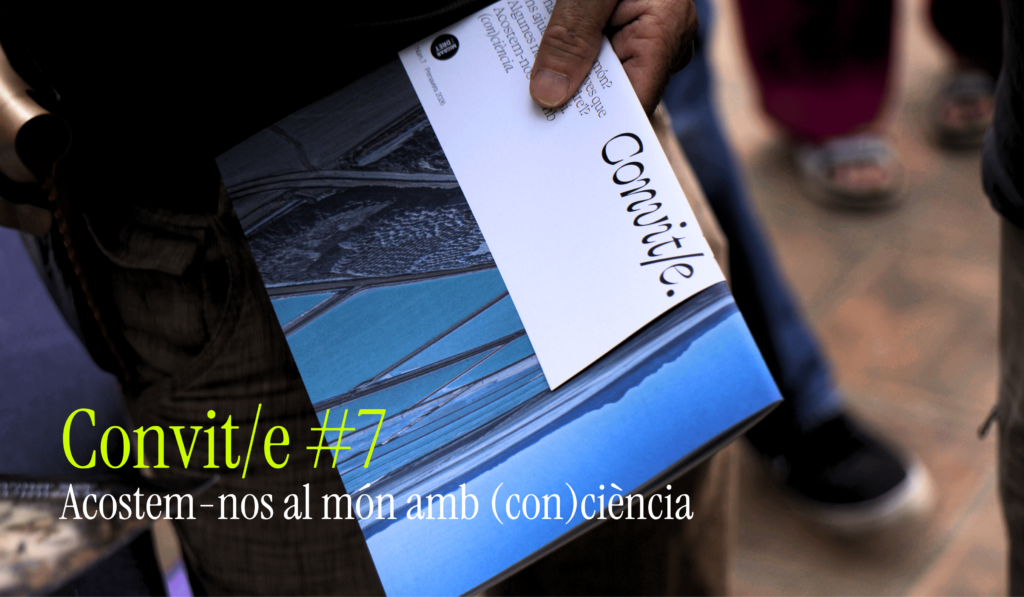
How does the world work? Are there objective reasons that help us understand it?
Issue No. 7 ofConvit/euses these questions as a starting point to approach science not as a realm reserved for laboratories or experts, but as a collective tool for observing, questioning, understanding, and transforming reality.
In a time marked by misinformation, the climate emergency, inequality, and rapid technological transformation, this new edition places scienceat the center. It does so by bringing together differentdisciplines and perspectives: biodiversity, genetics, health, technology, space exploration, science communication, education, ecology, and social justice.
We invite you to discover the main stories and reflections you'll find there.
The Value of Truth — Martín Habiague
We open the magazine with an editorial that champions an idea as simple as it is urgent:defending science is also defending democracy.
Martín Habiague draws a parallel between historical moments when knowledge was discredited and the current context, in which misinformation, mistrust of expertise, and the oversimplification of public debate are once again jeopardizing our collective ability to distinguish facts from self-serving narratives.
Science is presented here not as an immutable truth, but as a space for comparison, review, and discussion that allows us to make shared decisions with greater discernment.
Make Science Great Again! — Marc Campeny
What are the major scientific challenges of the second quarter of the 21st century?
Marc Campeny looks ahead to the next twenty-five years and raises issues that are already reshaping our future: the climate emergency, food sovereignty, genetics, global health, the energy transition, artificial intelligence, and space exploration.
The thread that unites them is clear: science cannot be a peripheral activity, nor can it depend on political trends or cycles. It requires investment, knowledge transfer, public debate, and a sense of social responsibility capable of ensuring that progress is not a privilege reserved for the few.
A Future Without Food? Biodiversity in Crisis — Irene Lobato Vila
What does the extinction of a species have to do with what we put on our plates?
Much more than we could ever imagine.
Irene Lobato Vila introduces us to the biodiversity crisis and explains that species loss is not just an environmental issue: it also weakens the functions that keep the ecosystems on which we depend running.
Pollinators, soil microorganisms, natural predators, and beneficial organisms are all part of a system that is essential to agriculture and, ultimately, to our food supply. The article thus leads us to the topic offood sovereigntyand the need to rethink what we eat, how it is produced, from whom we buy it, and which economic model we support through our consumption.
Are We Alone in the Universe? — Marina Martínez
It is probably one of the oldest and most fascinating questions we have asked ourselves as a species:Is there life beyond Earth?
Marina Martínez takes us from the very definition of life all the way to asteroids, Mars, and the icy moons of the solar system.
Samples from the asteroid Bennu have revealed some of the fundamental components related to the chemistry of life, while Mars, Europa, and Enceladus remain some of the major settings for astrobiological research.
Finding extraterrestrial life—even if it were microscopic—would not only be a scientific revolution: it would also transform the way we understand our place in the universe.
Challenges in Genetics in the Second Quarter of the 21st Century — Bernat Burriel
In just over twenty years, we've gone from needing more than a decade to sequence the first human genome to being able to sequence entire genomes in a matter of days.
Bernat Burriel explores one of the most dizzying scientific revolutions of our time: CRISPR and gene editing, organoids, paleogenomics, metagenomics, biobanks, the potential genetic restoration of species, and the use of artificial intelligence to interpret vast amounts of biological data.
But the great challenge will not only be to discover what we can do with genomes, but also to decidewhat we want to do with this knowledge and within what ethical, social, and political limits.
Challenges in Genetics in the Second Quarter of the 21st Century — Bernat Burriel
A smartwatch can detect a heart abnormality. The data can help predict risks. Telemedicine can connect a person living kilometers away from a hospital with a specialist.
But can technology alone solve health inequalities?
Hernán Lew reflects on the possibilities of Big Data and digital transformation in the healthcare sector, but also on their limitations. The neighborhood where we live, our housing, our work, our education, and our social connections can profoundly influence our health, and no algorithm can automatically correct these structural inequalities.
The article concludes by reminding us of a fundamental distinction:healing and caring are not exactly the same thing. Technology can be an extraordinary tool, but care still requires presence, community, and human relationships.
21st Century: I'll Explain Science to You… Will You Listen? — Eva van den Berg
We've never had so much information at our fingertips, and, paradoxically, it seems to get harder and harder to get us to stop and listen to it.
Eva van den Berg analyzes the current challenges facing science communication in a context dominated by screens, attention deficits, polarization, “alternative truths,” and a growing disconnect from nature.
The article argues for the need to rekindle curiosity, critical thinking, and scientific communication capable of explaining complex issues without compromising rigor. It also focuses on schools, the media, and the responsibility to continue telling important stories, even if they are not the easiest, most immediate, or most commercially viable ones.
The Natural Science Museum: Knowledge, Inclusion, and Scientific Careers
What role does a science museum play at a time when science is, at once, more present and more questioned than ever?
In this segment, we speak withAlbert Batlles and Greta Boix from the Barcelona Museum of Natural Sciences about the challenges facing museums today.
Serving as a source of rigorous, verified knowledge; putting audiences at the center; reaching out to those who cannot physically access museums; communicating complex content in an understandable way; and inspiring new scientific vocations are some of the major goals they have set for themselves.
Projects such asNiu de Ciència,El Niu Volant, andBressol de Ciènciaremind us that scientific curiosity can be cultivated from the earliest years of life.
Berta Cáceres: Science, Territory, and Resistance
Science is not created solely within a laboratory.
The figure ofBerta Cáceres—a Lenca indigenous leader, environmental activist, and human rights defender—allows us to broaden our perspective on the social sciences, ancestral knowledge, and the defense of territory.
Her struggle against extractivism and in defense of biodiversity brought together ecology, human rights, education, ecofeminism, and social justice. This holistic perspective continues to challenge us years after her assassination.
Maria Skłodowska-Curie: A Life Devoted to Knowledge
From Warsaw to Paris, from clandestine studies to two Nobel Prizes.
The magazine traces some of the key moments in the life ofMaria Skłodowska-Curie, from the difficulties she faced in gaining access to a university education to her research on radioactivity and the discovery of polonium and radium.
Her story is also that of a pioneer who paved the way for women in science and put knowledge to work for society, even developing mobile X-ray units during World War I.
Cultural Artefacts: Readings to Spark Further Thought
The reflection doesn't end on the last page of the magazine.
In“Cultural Artefacts,” you’ll find a selection of readings to continue exploring science from very different perspectives: Carl Sagan and the defense of skeptical thinking; Mileva Marić and the women rendered invisible in the history of science; Darwin and botany; traditional livestock farming and food sovereignty; forests, insects, biodiversity, and self-sufficient ways of life.
A small but diverse library to keep us asking questions even afterConvit/e closes.
An Invitation to View the World with (Scientific) Awareness
This issue does not aim to provide definitive answers. On the contrary: it invites us to keep asking questions.
Because talking about science means talking about how we produce food, how we take care of our health, who has access to technology, how we protect biodiversity, what we teach in schools, how we explain knowledge, and, ultimately,what kind of future we want to build.Science, culture, gastronomy, and society come together in these pages to remind us that understanding the world is also a way of caring for it.
Discover issue No. 7 of Convit/e, and let’s approach it together, united, with (con)sciousness.
SHARE
The most read
Other articles
Become a member
Become a Mescladís member and support our initiatives for a more inclusive and cohesive community.