
Xarxa BCN Antirumors: What It Is and How Mescladís Is Involved
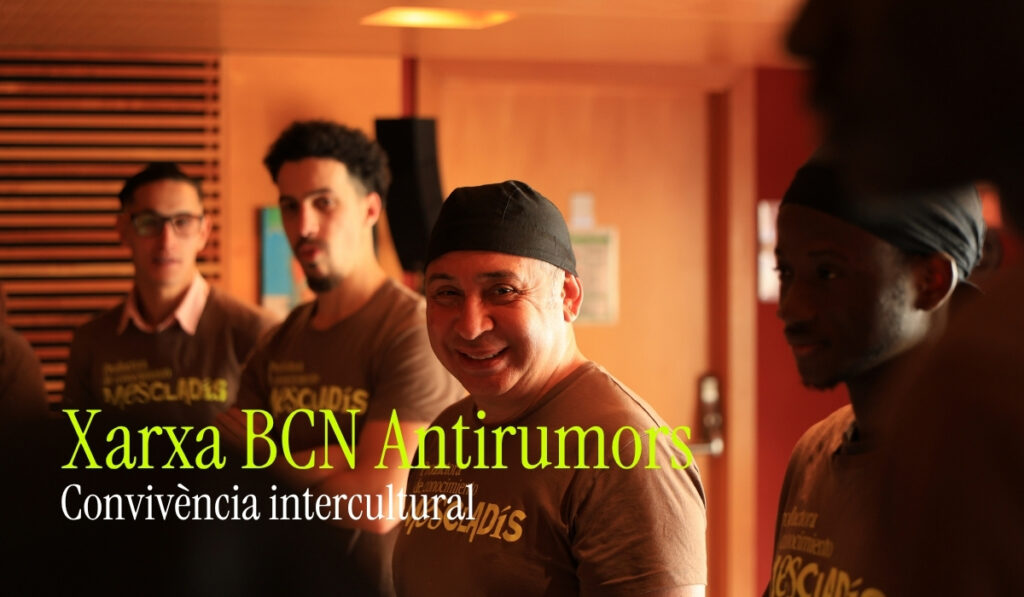
The Xarxa BCN Antirumors is a citizen-led network founded in 2010 in Barcelona to combat racism and xenophobia at their root: the rumors and prejudices that circulate without being questioned. It currently brings together more than a thousand organizations and has trained hundreds of people as “anti-rumor agents.” Mescladís participates through Fogons Antirumors, a culinary workshop where people with migrant backgrounds cook and share their culture with the public.
Combating racism and xenophobia is often associated with laws, institutional campaigns, or big headlines. But much of the discrimination suffered by certain groups—migrants, the LGBTQ+ community, people of color, people with neurodiversity, among others—is rooted in the accumulation of rumors: generalizations and prejudices that circulate unchallenged and are heard day after day, to the point of solidifying a collective “common sense.”
Based on this premise, the Xarxa BCN Antirumors was established 15 years ago, and Mescladís has been participating in it from its area of expertise: gastronomy as a space for gathering. It’s worth learning how this network works, what Mescladís contributes to it, and what real value this type of strategy holds in the current context.
This is not a closed program run in a top-down manner by the government: it is an open structure that is constantly evolving, with no end date, and whose development depends largely on the involvement of the participating organizations.
Network Growth in Numbers
The growth is significant when compared to the starting point. The network was launched in 2010 with 62 organizations. A year later, it had already grown to 245, including organizations, municipal facilities, parent-teacher associations, and neighborhood associations: more than four times as many in just a year and a half. Over the years, it has surpassed 1,000 members—a level of grassroots support that is unusual for this type of public policy, which typically loses momentum over time rather than gaining it.
The training of anti-rumor agents has followed the same upward trend: the number of people trained rose from 171 to 811 in the early years, and the activities listed in the Catalog reached more than 3,000 people. Furthermore, the model spread beyond Barcelona: by 2014, it was already being implemented in eleven European cities —including Bilbao, Sabadell, Botkyrka (Sweden), Erlangen (Germany), and Limerick (Ireland)—as part of the Council of Europe’s European C4i (Communication for Integration) project.
How It Works: The Three Areas of Focus
1. Training
Training forrumor-busters: volunteers from a wide variety of backgrounds—teachers, healthcare workers, journalists, and local residents—trained to identify a rumor and respond to it without causing confrontation.
2. Awareness-raising
A Catalog of Anti-Rumor Activities through which any school, organization, or facility can request—free of charge—a workshop, a forum theater performance, a comic book, or a guided tour.
3. Communication
Media and social media presence to counter specific rumors and highlight examples of intercultural coexistence.
A plan in constant evolution
In February 2023, the Network’s new Action Plan (PAX 2022–2026) was presented, developed through a participatory process involving member organizations. This consolidates the Network as a public policy initiative with a proven track record—fifteen years of experience—and mechanisms for periodic review.
The model has spread beyond Barcelona: L'Hospitalet de Llobregat launched its own network in 2024, and the project has been recognized as a best practice by European networks of intercultural cities.
Fogons Antirumors: Mescladís' Contribution
Mescladís participates in the Network from the field it excels in: the kitchen as a space for connection. As part of the Anti-Rumor Activities Catalog, it organizes “Fogons Antirumors,” a workshop in which, through the preparation of a dish, a group gains firsthand experience of the cultural diversity of their neighborhood and the city, guided by a person from that specific background.
Through cooking, the activity aims to promote:
- Respect and Recognition of Diversity
- Solidarity and Cooperation
- Knowledge Sharing
- Commitment to Citizenship
The guest—an immigrant—leads the session: they explain the key aspects of their country of origin’s cuisine, the stories behind the selected dish, the origins of the ingredients, the emotional connection to the dishes, the occasions on which they are typically enjoyed, and their symbolism. The session concludes with a shared tasting.
Why it works: direct contact, not rhetoric
The unique value of *Fogons Antirumors* is that it does not delegate the anti-rumor narrative to a third party who “explains” diversity. The active agent—who cooks, teaches, and shares a table and knowledge—is the migrant themselves. Stereotypes are eroded not through argumentation, but through direct contact with a firsthand story told in their own words.
Live together, not just coexist
Fifteen years and more than a thousand members are not enough to declare victory in the fight against racism and discrimination. But they are enough to affirm that this policy has found an approach that works and is sustainable over time—something that is difficult to achieve in this type of program.
Mescladís’ contribution shows how this methodology is sustained precisely in this way: through the sum of specific actions—a workshop, a meal, a conversation. These are, ultimately, the true arena where it is decided whether a city truly lives together or merely coexists.
SHARE
The most read
Other articles
Become a member
Become a Mescladís member and support our initiatives for a more inclusive and cohesive community.