
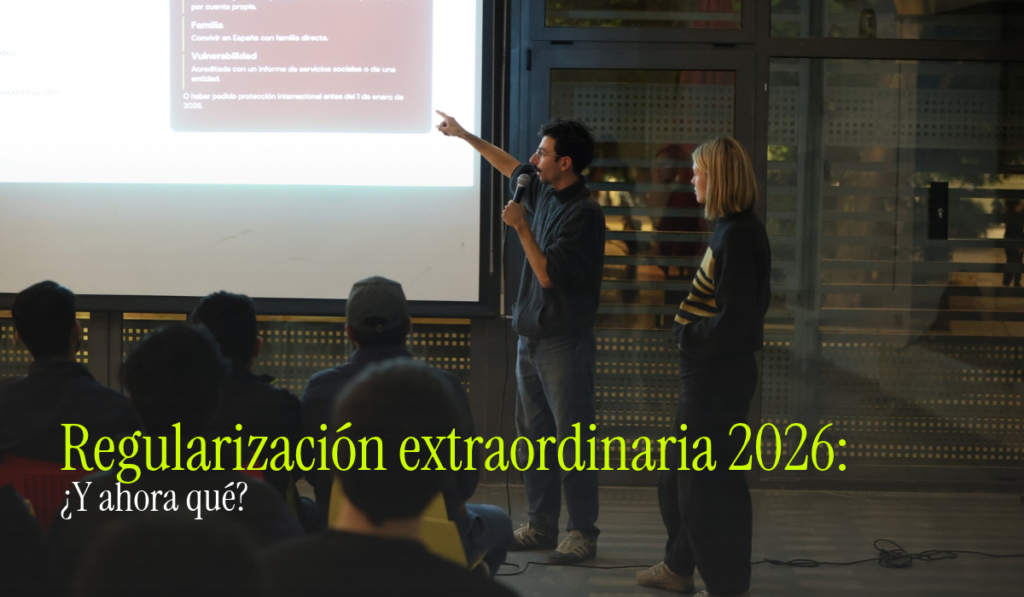
On Wednesday, November 4, we were at the Casal de Barri Pou de la Figuera alongside MigrAcció to address the question that has been coming up since the summer. Here’s what we discussed: what to do if you’re still waiting, if your application is already being processed, or if you’ve received a favorable decision.
There are questions that don’t fit on a form. Behind every file lies a life on hold: a job waiting for paperwork, a trip that can’t be taken, a date marked on the calendar without really knowing why. On Wednesday, November 4, 2026, one of those questions filled the Casal de Barri Pou de la Figuera: the deadline for extraordinary regularization has passed—so what now?
We organized the talk in collaboration with MigrAcció, the association of lawyers and legal professionals that assists migrants with their immigration procedures. Here is a summary of what we discussed, organized according to the stage each application is at.
Where We Are
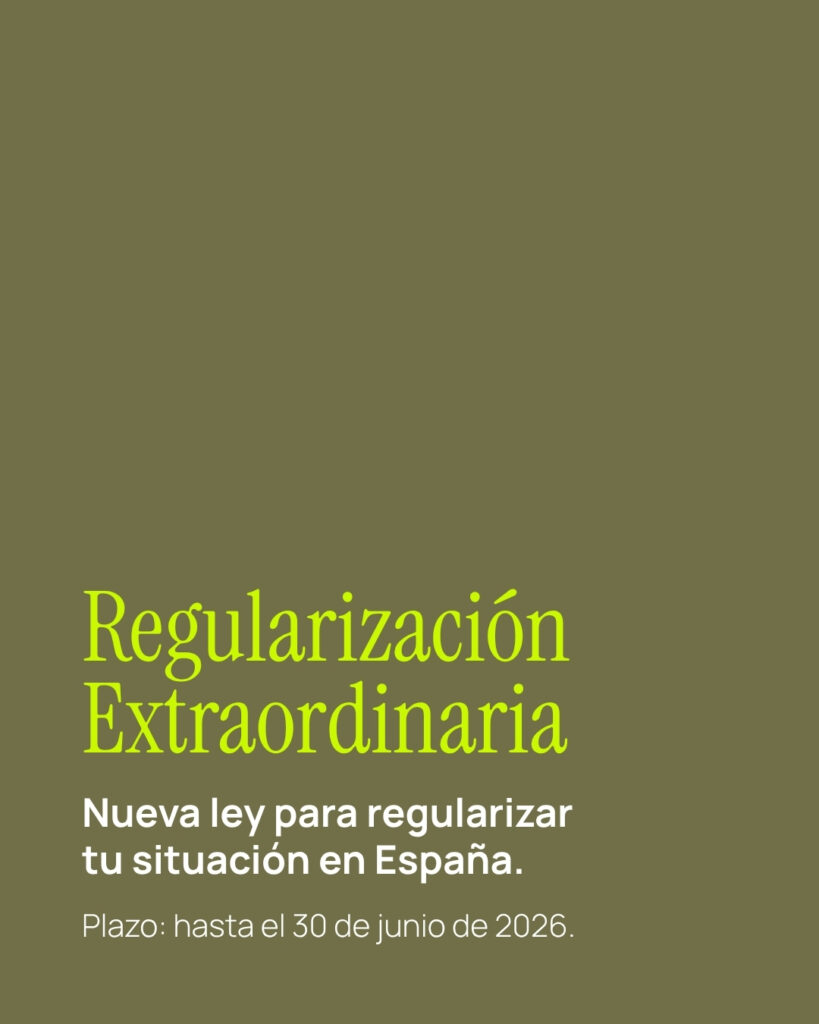
Applications could be submitted from April 16 to June 30, 2026. A total of 1,174,978 applications were received—more than double the 500,000 the government had expected—and by the deadline, the process had already resulted in 159,097 new enrollments in Social Security.
In early July, the State Secretariat for Migration reported approximately 12,000 final decisions. By the end of that month, the government had accepted 70% of the applications for processing. In August, it published an administrative directive in the Official State Gazette (BOE) to streamline the processing.
Since then, the pace has been irregular. There are no complete, up-to-date official statistics on applications accepted, authorizations granted, or pending cases, and decisions are not necessarily made in the order in which applications were submitted. Two applications submitted on the same day may be at different stages in the process, even though the regulations stipulate a three-month deadline for a decision. This is also what we see on the street.
Who signed up for the talk?
73 people signed up using a form, and each one told us what stage their application was at:
- 28 people (38.4%) have not yet had their cases accepted for processing.
- 35 people (47.9%) had their cases accepted for processing.
- 10 people (13.7%) with a favorable outcome.
This isn't a representative sample—it's just the people who signed up for a talk. Even so, it helps put a number on the wait time. Based on the data we have, it takes an average of about 63 days for an application to be accepted for processing, with cases ranging from one week to more than four months. A favorable decision is issued, on average, 144 days after the application is submitted—about five months.
From the start, MigrAcció made one thing clear: this was an informational session. No cases were taken on, nor were any new cases accepted during the session.
For your own case, your first point of contact remains the attorney or organization that filed the application.
If you applied and haven't heard back yet
It’s the hardest wait to endure, because there’s nothing to do but wait. But waiting doesn’t mean sitting idly by. In the meantime, the administration checks criminal and police records, as well as possible expulsions or alerts in the SIS (the Schengen Information System). If you think any of that might apply to you, check it right away and, if necessary, request that it be removed. A police record does not automatically lead to a denial; each case is evaluated on its own merits.
Three recommendations:
- Even if it's hard, be patient. Just because a case is delayed doesn't mean something is wrong.
- Check your notifications often, or ask your lawyer to let you know.
- Be wary of anyone who promises to speed up the process in exchange for money: no one can do that.
If your application is already being processed
The admission document serves as a provisional permit. It allows you to live and work legally throughout Spain while you await a response, whether you are employed by someone else or self-employed. And it does not expire after three months: it remains valid until a decision is made. It is important to keep three things in mind:
It is provisional. If the final decision is unfavorable, you lose your work permit and must notify the company immediately.
There is no ID card (TIE) yet. The admission slip itself serves as the ID.
There is a fee to pay: Form 790-052 (€38.28), within 10 business days of acceptance.
When it comes to work, the advice was clear: start working if you can, even if it’s just part-time, because every month you contribute counts toward the next step. Always make sure you have a written contract and are registered with Social Security: having a Social Security number isn’t the same as being officially registered. If you’re not working yet, sign up with the SOC (Servei d’Ocupació de Catalunya), which is free and gives you access to job openings and training; registration is renewed every three months.
And an important note: You cannot leave Spain with this document.
If you have received a favorable decision
The decision grants a one-year authorization, which begins on the date of the application, not when the response is received. Here’s a real-life example we shared during the talk: application submitted on May 15, 2026; decision issued on October 14; expiration on May 14, 2027. By the time the good news arrived, five months of that year had already passed.
The first step is to make an appointment to have your fingerprints taken and obtain your TIE. The processing time is one month, but there are very few appointments available; if you don't get one right away, don't worry—just keep trying. The appointment is free, and the fee for the card (Form 790, code 012) is different from the previous one. If someone charges you to get the appointment, it is not an official channel.
The most important part comes next: this authorization does not renew automatically. You must apply to have it replaced with a new one, starting two months before it expires and up to three months after. If the requirements are met, the new authorization is usually valid for four years; if not, an exceptional extension may be granted. That’s why, starting now, it’s a good idea to review your work history every few months and keep your contracts and pay stubs.
For everyone
No matter where you are in the process, there are four steps you can take to protect yourself: keep copies of everything (application, admission letter, fees, decision, contracts, and pay stubs) both on paper and on your phone; always work under a contract and with proper registration; do not leave Spain with only a provisional permit; and, if you receive any letters or have any questions, seek advice before taking action.
Key Facts
- Application period: April 16 through June 30, 2026 (now closed).
- Case accepted for processing: provisional permit to live and work in Spain until a decision is reached. This permit does not allow the holder to leave the country.
- Fee after admission: Form 790-052, €38.28, payable within the following 10 business days.
- Authorization following a favorable decision: one year, effective from the date of the application.
- TIE: Schedule an appointment to have your fingerprints taken within one month. If you can’t get an appointment in time, you won’t lose your authorization or your right to work—don’t worry, just keep trying. The appointment is free; the fee for the card is Form 790, code 012.
- Renewal of authorization: from two months before the expiration date until three months after. If the requirements are met, the authorization is typically valid for four years.
Where to Get Help
During the talk, we shared three resources:
- Organizations Providing Advice: Social organizations in the province of Barcelona that offer legal advice on regularization.
https://soliguia.cat/ca/search/provincia-barcelona/regularization - "Regularization Now!" Event: Help with applying for a digital certificate, registering with the SOC, and other procedures. https://script.google.com/macros/s/AKfycbxSNaccK1zwQBKNXsedJLSlY3mgffAQ-OC-KRnXZpqHEJGIRwb_0_UmEEYLmQCPzSRv/exec?page=i
- Barcelona Activa Guide: Explains to businesses what the "acceptance for processing" notice entails.
https://bcnroc.ajuntament.barcelona.cat/items/10db147c-e0aa-4f78-a28f-77baffe90751
Frequently Asked Questions
Can I work while my application is being processed? Yes. The notice of acceptance allows you to work legally throughout Spain—whether as an employee or self-employed—until a decision is reached. You must always have a written contract and be registered with Social Security.
Can I travel outside of Spain while I wait? No. With the provisional permit granted upon acceptance of your application, you cannot leave Spain.
Can anyone expedite my application if I pay them? No. No one can expedite an application in exchange for money, and the appointment to have your fingerprints taken for the TIE is free. If someone charges you for it, it is not an official process.
What happens when the one-year authorization expires? It does not renew automatically. You must apply for a new authorization between two months before and three months after the expiration date. If the requirements are met, the new authorization is typically valid for four years.
At Mescladís, we’ve been creating training and job opportunities for migrants through cooking since 2005. We know that a piece of paper isn’t just a piece of paper: it’s the gateway to a job contract, to training, to a life where you can finally make plans. The extraordinary regularization process didn’t end when the deadline passed. Now another phase begins—one of waiting, taking care of your paperwork, and preparing for the next step. No one should have to go through this alone.
We share a table; we share a journey.
Information reviewed by MigrAcció and updated as of November 2026. This article is for informational purposes only and does not replace advice regarding individual cases.
SHARE
The most read

Other articles


Become a member
Become a Mescladís member and support our initiatives for a more inclusive and cohesive community.